Why Narrative Notes Lose Clinical Intent Over Time
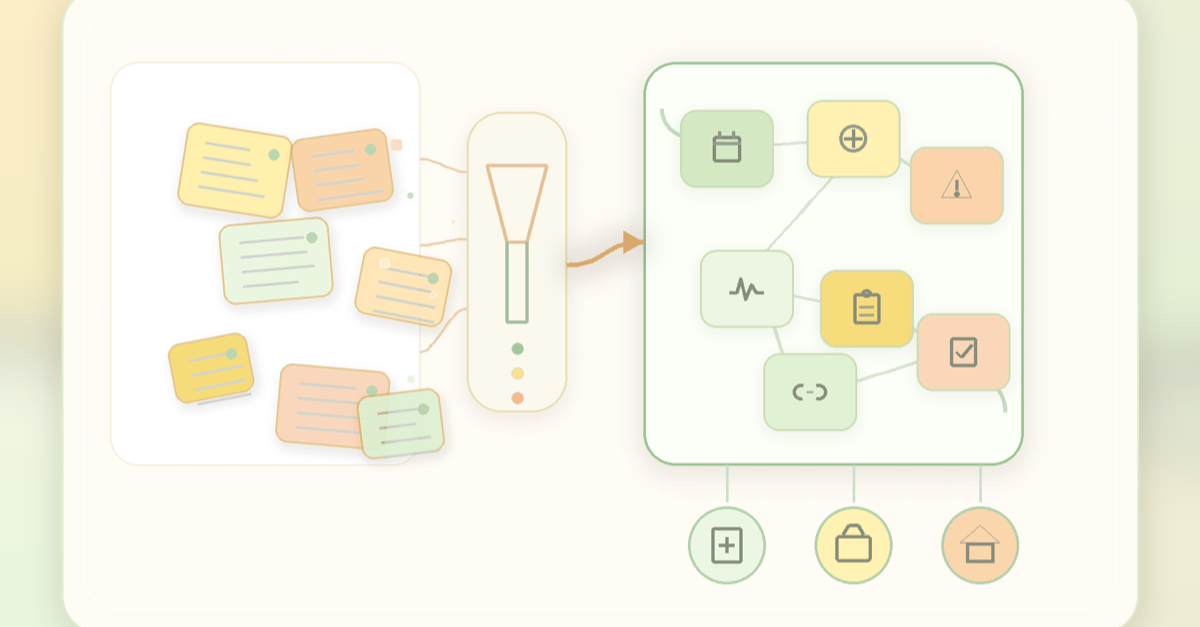
Clinical intent as portable state
Narrative-type clinical notes are flexible and familiar. But clinical intent needs a way to travel across hospital, clinic and home. FHIR gives it a standards-based path.
This is the second article in the clinical documentation and FHIR series, focused on how intent, responsibility and uncertainty can survive beyond the original note.
The narrative note is powerful, but fragile in the modernising digital world we move in now.
Clinical notes have endured because they are useful. But on their own, they remain too unstructured to carry clinical intent safely across the evolving healthcare horizon.
A clinician can use narrative prose to describe what structured fields often struggle to capture: symptoms, uncertainty, examination findings, diagnostic reasoning, patient concerns, family context, risk, treatment decisions, follow-up plans, and medico-legal judgement.
That flexibility matters.
It allows nuance. It allows explanation. It allows the clinician to record not only what was decided, but why it was decided.
But the same flexibility that makes narrative notes powerful also makes them somewhat brittle.
Narrative notes are not inherently operational. They can describe clinical intent, but they do not reliably preserve that intent in a form that travels across time, teams, systems, and care settings.
This becomes increasingly important as care becomes more distributed. Notes are and will be, unstructured.
A paragraph may contain the plan, but the plan may not be visible to the next system that needs it. A sentence may contain uncertainty, but that uncertainty may not be tracked. A phrase may imply responsibility, but the responsible person may not be explicit. A result may be mentioned, but its impact on the patient's current state may not be clear.
This is the problem of loss of clinical intent.
The record may continue to grow, while the meaning of the record becomes harder to recover.
The note is asked to do too much
The traditional clinical note is often expected to perform several jobs at once.
It is a memory aid, a medico-legal record, a communication tool, a handover document, a reasoning space, a care plan, a safety-net record, a referral source, an audit trail, and a future reconstruction of what happened.
That is a heavy burden for one narrative object.
A well-written note can support many of these functions, but it cannot reliably perform all of them on its own. The more complex the patient journey becomes, the more the note is forced to carry information that should ideally be visible, structured, traceable, and actionable elsewhere.
The problem is not that clinicians write poor notes. The problem is that the note has become the centre of a system it was never designed to operate.
Intent is different from information
Healthcare systems contain a vast amount of information. They contain notes, results, scans, medication lists, discharge summaries, referrals, messages, care plans, patient instructions, and administrative records.
But clinical care does not depend on information alone. It depends on intent.
Clinical intent answers questions such as:
- Why is this patient being referred?
- What problem is actively being managed?
- What risk is being monitored?
- What result is being awaited?
- What uncertainty remains?
- What treatment response is expected?
- What would count as deterioration?
- Who is responsible for the next step?
- What should the patient do if things change?
Narrative notes may contain these answers, but they often bury them inside prose.
When care is simple, this may be manageable. A single clinician, a single problem, and a short timeframe allow intent to remain relatively clear.
When care is complex, the risk increases.
A patient may see multiple clinicians across multiple organisations. Each clinician may read only part of the record. Each service may use a different system. Each handover may compress the story further. Each new note may describe the current encounter without preserving the original reason for action.
Over time, information accumulates.
Intent degrades.
How is intent lost over time?
Clinical intent is rarely lost all at once. It usually fades through small acts of compression.
A clinician documents a plan in prose. A referral letter summarises only part of that plan. A discharge summary condenses the admission. A later note focuses on the new encounter. A result is filed without being clearly linked back to the question it was meant to answer. A patient remembers some instructions but not the rationale. A new clinician reads the most recent note, not the whole chain.
Nothing dramatic has to happen.
The system simply becomes less certain about what was meant.
The clinical record still contains data, but the logic connecting that data becomes weaker. The "why" behind an action becomes harder to find. The boundary between resolved, unresolved, and uncertain becomes blurred.
This is especially important in longitudinal care.
Longitudinal care requires state, not just prose
Longitudinal care depends on continuity. Continuity depends on understanding what has changed over time.
The narrative note was not designed to function as a longitudinal state engine. It does not automatically track whether a symptom is new, stable, worsening, improving, fluctuating, or resolved. It does not automatically connect a new blood result to a prior plan. It does not identify that a referral question remains unanswered. It does not show that a safety-net instruction was given but never followed up. It does not surface that responsibility has shifted from one service to another.
Instead, clinicians often have to reconstruct the clinical story manually.
They scan previous notes, search for old results, compare imaging reports, rely on patient memory, and infer prior intent from incomplete documentation. They try to decide whether the current issue is new or known, urgent or chronic, expected or unexpected.
This cognitive load is not trivial.
It consumes time. It increases duplication. It can delay escalation. It can obscure accountability. It can make it harder to distinguish deterioration from expected variation.
A well-written note helps. But even a well-written note is still largely a human-readable object. It is not necessarily a computable, auditable, state-aware object that can travel between systems.
That distinction matters.
Prose does not naturally preserve responsibility
One of the most important weaknesses of narrative documentation is ambiguity of responsibility.
Many clinical plans contain actions, but not clear ownership.
- "Repeat bloods in six weeks."
- "Consider respiratory referral if symptoms persist."
- "Await MRI."
- "Patient to monitor symptoms."
- "Review if worsening."
- "Discuss with cardiology."
- "Follow up after imaging."
These statements are clinically sensible. They are also operationally incomplete.
Who is arranging the blood test? Who is reviewing the result? Who is responsible for acting if the MRI is abnormal? Who decides whether symptoms have persisted long enough to trigger referral? What does "worsening" mean for this patient? When should the patient escalate? What happens if the patient does not attend follow-up?
Narrative prose can answer these questions, but only if the clinician writes them explicitly and the next person reads them carefully.
That is a weak safety model.
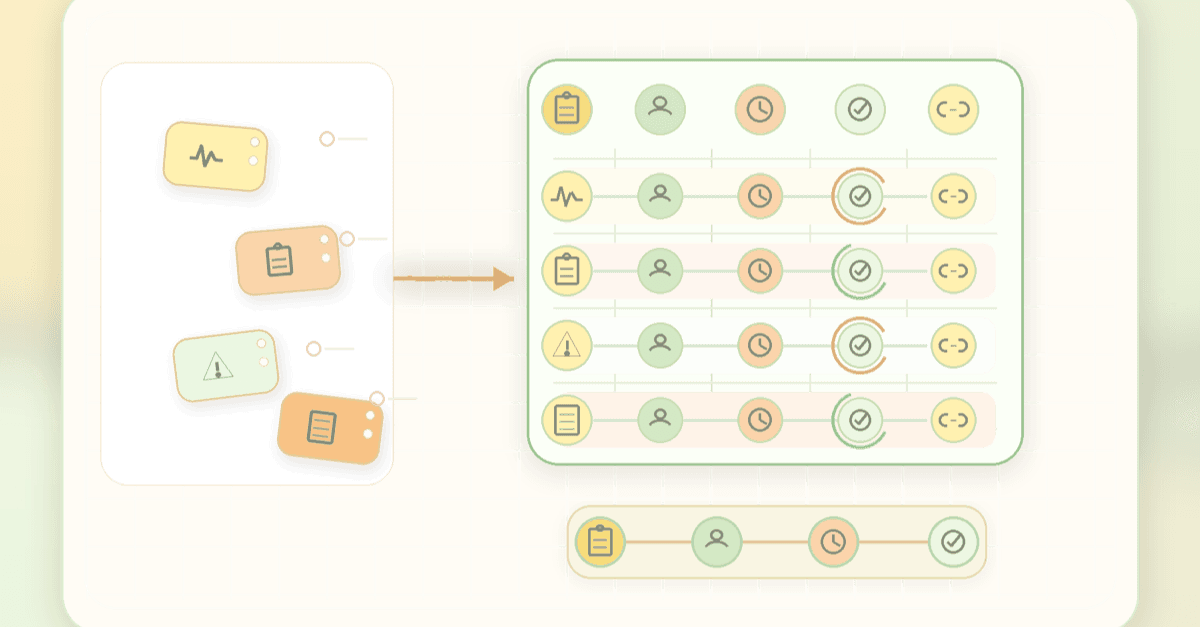
Healthcare needs documentation systems that make responsibility visible. Not every action requires complex workflow automation, but every clinically meaningful action should be able to carry ownership, timeframe, rationale, and escalation logic.
Responsibility should not have to be inferred from a sentence. It should be part of the clinical state, and it should travel with the patient.
Prose does not naturally preserve uncertainty
Clinical uncertainty is normal.
A good clinician does not only state what is known. They also define what is not yet known, what needs to be watched, and what would change the working diagnosis.
A note may say:
- "Possible inflammatory cause."
- "Likely mechanical pain."
- "Cannot exclude early infection."
- "Await pathology."
- "Monitor for progression."
- "Diagnosis remains unclear."
These statements matter.
They define the boundary between current knowledge and future risk.
But in narrative notes, uncertainty can easily disappear. It may be overwritten by later summaries. It may be omitted from referral letters. It may not appear in patient-facing explanations. It may not be linked to a follow-up action.
The result can be a false sense of certainty. This is particularly important for clinical AI.
A system that produces polished prose without preserving uncertainty may make care look more settled than it is.
That is not a documentation improvement. It is a risk.
Clinical AI should not simply make notes smoother. It should make uncertainty more visible, traceable, and manageable across every system that receives the record.
Prose does not naturally preserve state change
A narrative note may describe symptoms, signs, results, and decisions, but it may not explicitly encode state change.
Consider a patient with COPD.
A note may document cough, sputum, oxygen saturation, inhaler use, steroid treatment, and follow-up. But the clinically important questions are dynamic:
- Is this an exacerbation?
- Is the patient returning to baseline?
- Is oxygen requirement new?
- Is sputum changing?
- Has exercise tolerance declined?
- Has the patient had recurrent admissions?
- Is home support adequate?
- Has the risk profile changed?
The same applies across chronic disease.
For diabetes, the issue is not only the latest HbA1c. It is whether glycaemic control is improving or worsening, whether renal risk has changed, whether hypoglycaemia has occurred, whether medication adherence has shifted, and whether cardiovascular risk is being actively managed.
For ischaemic heart disease, the question is not only whether chest pain exists. It is whether the angina pattern has changed, whether exercise tolerance has reduced, whether testing has altered risk, and whether responsibility has shifted from acute care to outpatient follow-up.
Narrative can hold all of this. But it usually requires the reader to reconstruct it.
And every act of reconstruction is an opportunity for loss.
A state-aware documentation system should make these changes explicit: not only readable, but structured, computable, auditable, and portable. This is where clinical documentation has to stop being only a paragraph and start becoming part of an interoperable data layer.
FHIR changes the centre of gravity
However, FHIR does not replace clinical judgement.
It does not replace narrative. It does not, by itself, create safe care coordination.
But it does provide something narrative notes cannot provide on their own: a standards-based way to represent clinical and administrative facts as structured resources that can be exchanged, referenced, updated, and governed.
HL7 describes FHIR resources as structured data objects used to exchange or store healthcare data. Resources have known identities, defined types, structured data items, and versioning behaviour. A Bundle can group resources together for exchange, messaging, transactions, storage, or clinical documents.
That matters because clinical intent is rarely a single sentence.
It is usually a set of linked objects:
- a patient
- an appointment
- an encounter
- a condition
- an observation
- a request
- a result
- a plan
- a task
- a consent
- a document
- a provenance record
A note can describe those objects. FHIR can help them travel.
Appointment schedules. Encounter anchors. Bundle carries.
The clinical encounter is not just a moment in time.
It is the natural anchor for what happened, what was decided, what remains uncertain, and what now needs to move across the care system.
In FHIR, an Appointment represents a planned meeting, which may include examples such as scheduled surgery, follow-up visits, or clinician case discussions. An Encounter represents the interaction between a patient and healthcare provider for healthcare services or assessment. HL7 also describes how an Appointment is normally used for planning and can be linked to a newly created Encounter when care begins.
So the more precise model is this:
The Appointment schedules.
The Encounter anchors.
The Bundle carries.
The Appointment is the operational entry point. It tells the system that care is planned.
The Encounter is the clinical anchor. It tells the system that care occurred, or is occurring, and gives related clinical resources a common point of reference.
The Bundle is the portable package. It allows the relevant resources to move together with enough linkage to preserve meaning.
This is a better model than asking the narrative note to carry everything alone.
A discharge summary can be represented as a Composition supported by linked resources. A referral can be represented as a ServiceRequest linked back to the originating Encounter. A pathology or imaging request can be represented as a ServiceRequest with status, intent, reason, timing, supporting information, and links to fulfilment workflow. A result can be represented through DiagnosticReport and Observation resources. Provenance can record who created or transformed the data, when, and from what source.
Australia's interoperability direction is increasingly aligned with this resource-based model. The National Healthcare Interoperability Plan 2023-2028 identifies 44 actions across priority areas including identity, standards, information sharing, innovation, and measuring benefits. AU eRequesting R1 is also now a current published working standard based on FHIR R4, focused on pathology and medical imaging requests in community-based care.
The implication is significant. The note remains important. But it is no longer the only vehicle of portability.
The clinical state can move with the patient.
Why this changes the documentation problem
Once the encounter is treated as a clinical state transition, the failure modes of narrative notes can be addressed more directly.
Responsibility no longer has to be inferred only from a sentence. A Task can carry status, intent, requester, owner, patient, encounter, priority, and timing information, depending on the FHIR version and implementation profile. Task resources are designed to describe activities to be performed and to track their state through completion.
Uncertainty no longer has to live only as a buried qualifier in prose. A Condition can carry a verification status such as unconfirmed, provisional, differential, confirmed, refuted, or entered-in-error.
Pending questions no longer have to depend only on memory. A ServiceRequest can represent a request for a diagnostic investigation, procedure, consultation, therapy, or other service, with status, intent, reason, supporting information, and links to downstream results or procedures.
State change no longer has to be reconstructed entirely by the next reader. Observation resources can form trajectories over time. If identifiers, timestamps, codes, and provenance are implemented well, a system can help clinicians see whether a result, symptom, risk marker, or functional measure is improving, worsening, stable, or unresolved.
Provenance no longer has to be an informal act of trust. A Provenance resource can identify information about another resource and can be used within document bundles or RESTful systems to track where data came from, who participated, and how content was created or transformed.
This is the leap. Not from paper notes to digital notes.
From notes-as-record to encounter-as-state transition.
A worked example: from rooms to theatre to home
Consider a patient seeing a specialist in private rooms.
The Appointment is booked. The Encounter occurs. The specialist documents history, examination, working diagnosis, planned surgery, anaesthetic risk, consent status, and follow-up plan.
In a conventional workflow, much of that information lives in a letter and a clinical note. It may be copied to the GP by secure messaging, transcribed into a hospital admission form, re-entered into a theatre scheduling system, and partially summarised in a discharge letter after surgery.
Each transition creates an opportunity for loss.
The referral question may become less clear. The working diagnosis may sound more certain than it is. The consent status may need to be checked again. The follow-up plan may be split across systems. The GP may receive the discharge summary but not the full rationale for what should happen next.
In a FHIR-anchored workflow, the same clinical event can generate a structured set of resources.
The Appointment schedules care.
The Encounter anchors the clinical event.
The working diagnosis becomes a Condition with verification status.
The planned operation becomes a ServiceRequest or related procedure workflow.
Risk assessments can be represented as Observations.
The follow-up plan can be represented through CarePlan and Task resources.
Consent can be represented as a Consent resource.
Provenance can record who created or validated each part of the package.
A Bundle can carry the relevant resources together.
The receiving hospital still needs local workflow, conformance, governance, and system integration. FHIR does not remove that work.
But it can reduce the need to reconstruct intent from prose alone.
The theatre team can receive structured facts rather than only a letter. The pre-admission team can see linked risks and consent status where those resources are supported. The discharge process can add new resources to the same chain: Procedure, MedicationRequest, updated Condition, follow-up ServiceRequest, CarePlan items, and Tasks.
When the patient returns home and the GP opens the record, the GP should not have to infer everything from a paragraph.
They should be able to see structured state: This is known as "understand the delta".
What changed?
What remains uncertain?
What is pending?
Who owns the next step?
What the patient has been told to do?
Same patient. Same clinical journey. But the intent travels.
Where Regenemm fits
A documentation system that treats the encounter as a state transition needs a substrate underneath it that can carry that state across organisational boundaries.
FHIR is that substrate.
Regenemm is built to operate on top of and around and beside it.
The Regenemm Clinical Document Aggregator, or RCDA, aggregates encounter evidence and produces governed outputs. Those outputs are not only notes and letters. They can be FHIR-shaped artefacts: structured Conditions, Observations, ServiceRequests, CarePlans, Tasks, Consents, Provenance records, Compositions, and Bundles.
The Parallel Patient Context Engine, or PPCE, maintains longitudinal state across encounters and packages. When a new encounter occurs, prior state does not have to be reconstructed only from prose. It can be addressed as part of the patient's evolving clinical context.
Clinical context cards capture smaller state-relevant units: a symptom change, an examination finding, an image, a video, a documented uncertainty, a transfer of responsibility, a patient instruction, a result awaiting action. These are the structured atoms that prose can easily dissolve.
The narrative note remains where narrative is valuable. But the encounter becomes more than an isolated paragraph.
It becomes a governed state transition, anchored by clinical context and capable of producing interoperable outputs.
That is the shift. Regenemm is not trying to remove the note. It is trying to stop the note from carrying the whole system alone.
Closing argument
Narrative notes will remain part of medicine because medicine requires narrative. But narrative alone is no longer sufficient.
Modern care is distributed, longitudinal, multidisciplinary, and increasingly data-rich. Patients move between clinicians, services, systems, and settings. Clinical intent must move with them.
If documentation only records what happened, it will continue to lose meaning over time.
If documentation also produces structured, FHIR-anchored artefacts at every encounter, it can carry what changed, what it means, what remains uncertain, what action follows, and who is responsible.
That is how documentation moves from passive record to active clinical infrastructure.
And that is how the encounter becomes more than a paragraph in someone's chart.
It becomes the data package that helps hold a patient's care together.